Bitcoin mining has had some rather dramatic twists over the past decade. Mining started out as a CPU and later GPU-powered niche community, and has transformed into a multibillion-dollar industrial sector, characterised by extreme political shifts with countries taking a positive or negative stance, massive energy consumption debates, wildcat explorers onboarding new energy sources or stranded energy sources, green energy miners and even governments themselves openly mining.
As Bitcoin mining has graduated to industrial, warehouse-scale operations with thousands of ASICS, it is increasingly inaccessible to everyday individuals through innovative hardware solutions. Very few Bitcoiners have the means to put up cash to buy an ASIC, nor the cheap electricity to mine at a rate that would be cost-effective compared to stacking.
While there are certain conditions where it can still be a viable sat stacking operation, if you can successfully secure a second-hand miner and you have, for example, excess solar energy you want to use, the exceptions don’t disprove the rule.
The average user is priced out of mining on both the machinery and energy consumption sides.
This barrier to entry means hash rate is centralised around the large private, public, or government-run entities, so what is a pleb to do?
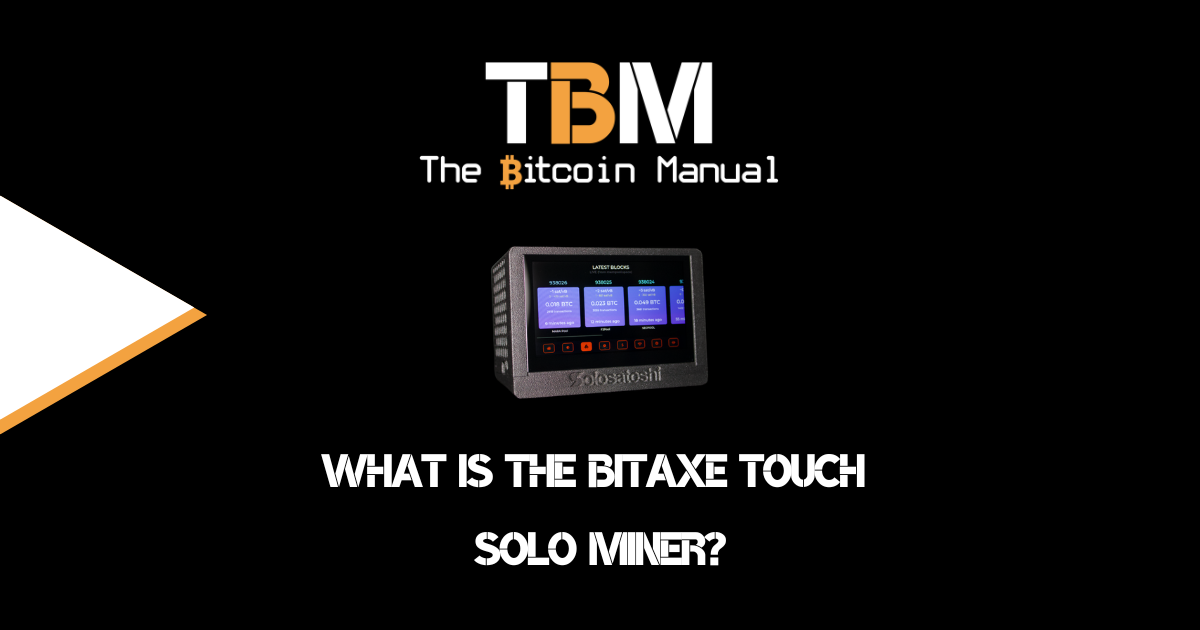
Well, you gotta fight for your right to hash, and that’s what pleb mining is all about, with projects like Solo mining rigs, solar mining rigs and desktop lottery miners. At the forefront of this democratisation movement stands the BitAxe platform, with the recently launched BitAxe Turbo Touch representing the latest version in open-source, home-based mining technology, aimed at reaching casual users and growing the mining community.
What Are BitAxe Miners?
BitAxes are compact, open-source bitcoin mining devices designed specifically for hobbyists, home miners, and Bitcoin enthusiasts who want to participate in the network without massive capital expenditure or electricity consumption.
Unlike traditional ASIC miners from manufacturers like Bitmain that consume thousands of watts and produce deafening noise levels, BitAxes are engineered to be quiet, efficient, and fully transparent—every line of code is publicly available for scrutiny and modification.
The appeal of BitAxes isn’t a get-rich-quick scheme or even a technological breakthrough that puts you on the same playing field as the big boys; it’s merely a philosophical commitment to decentralisation and transparency in the Bitcoin ecosystem.
Because the devices are open-source, users can verify exactly what the hardware is doing, from the silicon chips to the display pixels. This stands in stark contrast to the proprietary nature of most industrial mining equipment, where users must place implicit trust in manufacturers as they aim to maintain trade secrets and a competitive edge over one another and secure a larger market share for themselves.
The BitAxe Family: A Growing Lineup
The BitAxe platform has evolved significantly since its inception, with several models now available to meet different mining preferences and budgets. The lineup includes models like the BitAxe GT 801, which serves as the foundation for the newer Turbo Touch variant.
Each generation of BitAxe has pushed the boundaries of what’s possible in compact mining hardware, and the look and feel is starting to resemble a home gaming console with plug-and-play simplicity.
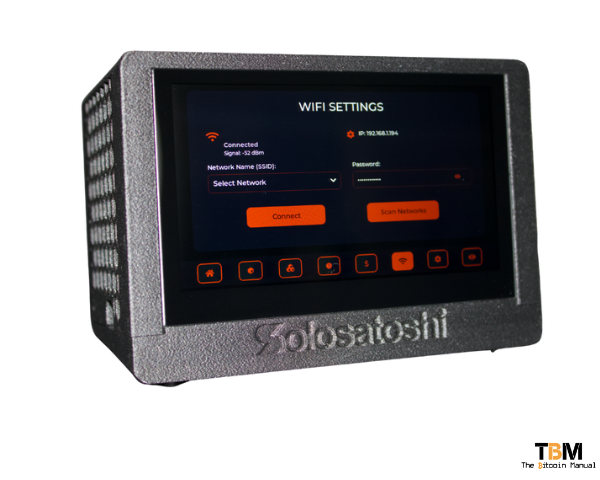
The BitAxe Touch concept emerged in late 2024 as a collaboration within the open-source mining community, combining the power of dedicated ASIC chips with an intuitive interface that displays real-time mining metrics, network data, and Bitcoin price information directly on a built-in screen.
The BitAxe Turbo Touch, launched by Houston-based Solo Satoshi in early 2026, represents the current pinnacle of the BitAxe platform. This device delivers more than double the hashrate of competing touchscreen miners, producing approximately 2.15 terahashes per second (TH/s) from its dual BM1370 ASIC chips—the same chips found in the industrial-scale Bitmain Antminer S21 Pro.
The Rise of Solo Mining: A Cultural Shift in Bitcoin
For most of Bitcoin’s history, individual miners were forced to pool their computational power together, combining their hashing efforts to receive consistent, smaller payouts. Solo mining—where a miner attempts to find blocks entirely on their own—was largely a pursuit for those with massive operations or unrealistic expectations.
However, this dynamic has shifted dramatically in recent years. A growing number of Bitcoin enthusiasts have embraced solo mining as a philosophical statement and a legitimate strategy, particularly those seeking to secure their own blocks and maintain a direct relationship with the Bitcoin network.
Solo mining is experiencing a renaissance driven by several factors: technical accessibility improvements in devices like BitAxes, increased media coverage of unlikely solo-mining successes, and a deep desire within the Bitcoin community to resist further centralisation of the network.
Solo Mining Pools: The Bridge Between Individual and Collective
To address the inherent variance problem of solo mining—where an individual miner might go months or years without finding a block—solo mining pools have emerged as an innovative solution. These pools operate differently from traditional mining pools.
Rather than combining hash power to find blocks more frequently (with rewards distributed to members), solo mining pools offer a middle ground where individual miners contribute to a collective that shares block discovery and associated benefits.
Solo mining pools like SoloPool or Parasite Pool allow miners to maintain the philosophical purity of solo mining while improving their odds of success through pooled resources. The block discovery is still credited to individual miners, but the pool structure provides regular rewards and reduces variance. This hybrid approach has become increasingly popular among serious home miners and those operating BitAxe-class hardware.
When BitAxe Miners Strike It Rich
The Bitcoin mining community has been captivated by several high-profile instances of BitAxe miners discovering blocks—a feat previously considered nearly impossible for small operations. These success stories have generated significant media attention and transformed public perception of home mining from a pointless hobby to a legitimate, if extraordinarily fortunate, way to earn Bitcoin.
In one remarkable case, a solo miner operating modestly-powered equipment discovered a Bitcoin block and claimed the associated block reward plus transaction fees—a windfall that would have been unimaginable just a few years prior. These tales capture the imaginations of Bitcoin enthusiasts worldwide, demonstrating that block discovery, while still extraordinarily unlikely for individual miners, is technically possible, just not probable.
But we all have a degen in us, and lottery mining can be a way to feed that addiction without ending up in shitcoin territory.
| Miner | Block | Year | Reward (BTC / USD est.) | Hardware |
| Bitaxe Pocket Rig | 887,212 | 2025 | 3.150 / $258K | DIY Bitaxe (~480 GH/s) |
| Bitaxe Ultra User | 913,632 | 2025 | 3.144 / $344K | 500 GH/s device |
| Bitaxe Gamma Miner | 889,975 | 2025 | 3.149 / $260K | 1.2 TH/s @ 18W setup |
| Anonymous Bitaxe | 883,181 | 2024 | 3.150 / $308K | Bitaxe variant |
| FutureBit Apollo Owner | 881,423 | 2025 | 3.150 / $326K | ~1 TH/s hobbyist rig |
| Cloud Burst Gambler | 899,826 | 2025 | 3.125 / $330K | 259 PH/s (rented) |
| $300 Setup Miner | 920,440 | 2025 | 3.151 / $347K | Likely Bitaxe-based |
The coverage of BitAxe miners isn’t just a way to cheer for the underdog; securing blocks has served multiple purposes within the Bitcoin ecosystem.
- First, it provides compelling human-interest stories that attract new participants to Bitcoin and mining.
- Second, it validates the decentralised ethos of Bitcoin by showing that you don’t need industrial-scale operations to contribute to the network.
- Third, it demonstrates the potential upside of home mining, even if that upside remains statistically improbable for any individual operator.
The BitAxe Turbo Touch: Specifications and Features
The BitAxe Turbo Touch is purpose-built for hobbyists seeking serious mining performance in a compact form factor. Here are the key specifications:
- Performance and Efficiency: The device produces approximately 2.15 TH/s of hash power, with peak performance reaching over 3 TH/s under overclocking. It achieves efficiency of roughly 18 joules per terahash, making it one of the most efficient home mining devices available. Its power consumption is merely 43 watts, translating to approximately $3.70 monthly operating costs at typical US residential electricity rates.
- Hardware: The Turbo Touch uses dual BM1370 ASIC chips—enterprise-grade silicon that brings industrial mining capability down to desktop scale. These are the same processors found in Bitmain’s Antminer S21 Pro, but integrated into a form factor suitable for home environments.
- User Interface: The 4.3-inch capacitive touchscreen displays eight rotating information panels showing hashrate performance, Bitcoin price, current block height, recently mined blocks, and other network metrics. This real-time feedback creates an engaging experience far superior to traditional headless mining operations, which simply run silently in the background.
- Transparency: Both firmware layers—AxeOS (managing mining operations) and BAP-GT-TOUCH (powering the interface)—are completely open-source. Hardware schematics and board layouts are publicly available under open hardware licenses, allowing the community to audit, modify, and improve the design.
- Connectivity: The device connects via 2.4 GHz Wi-Fi using an ESP32-S3 microcontroller. Configuration occurs through a browser-based dashboard, making setup straightforward for users without advanced technical knowledge.
- Noise Levels: At approximately 35 decibels, the Turbo Touch is remarkably quiet—closer to a library conversation than traditional mining rigs.
- Manufacturing: Each unit is assembled and tested in the United States before shipping, ensuring quality and supporting local manufacturing.
Cost Efficiency and Competitive Positioning
Solo Satoshi positions the BitAxe Turbo Touch as a superior alternative to competing touchscreen miners like the Braiins BMM 101. The cost-per-terahash metric is particularly compelling: approximately $151 per TH for the Turbo Touch compared to roughly $299 per TH for competing devices. This two-to-one advantage in cost efficiency makes the Turbo Touch an attractive option for home miners prioritising value.
The Broader Ecosystem: Open-Source Hardware Movement
The BitAxe Turbo Touch doesn’t exist in isolation. It’s part of a broader movement toward open-source bitcoin mining hardware that represents a philosophical challenge to proprietary mining equipment. According to Solo Satoshi, open-source bitcoin miners have collectively produced more than $1 million in verifiable block rewards, proving the viability of transparent, community-auditable hardware.
The development of the Turbo Touch involved collaboration with the Open Source Miners United community, a network of developers and enthusiasts committed to advancing transparent mining hardware. This collaborative approach has yielded innovations like proprietary communication protocols, allowing developers to build custom displays and hardware integrations.
Hobbyist and Home Mining
The BitAxe Turbo Touch is yet another offering in the growing list of options for ordinary people who want to support the Bitcoin network. Today, for less than $1 000, you can run your home node with industrial-grade ASIC performance, household-friendly power consumption, complete transparency, intuitive interfaces, and exceptional cost efficiency.
Whether you’re drawn to mining for the possibility of discovering a block, the cost appeal of low-power operation, or the principle of supporting a decentralised network, the BitAxe Turbo Touch offers a compelling entry point. As solo mining gains cultural acceptance and technological refinement continues, devices like this will likely play an increasingly important role in the Bitcoin ecosystem.
While home miners will never be the dominant force on the network, they do provide additional hash rate that is far more distributed and harder to disrupt. If, for any reason, a country or region becomes hostile to Bitcoin and aims to shut down large miners, home miners remain unaffected; all that happens is they become a greater share of the network for the time being, with a better chance of securing a block.