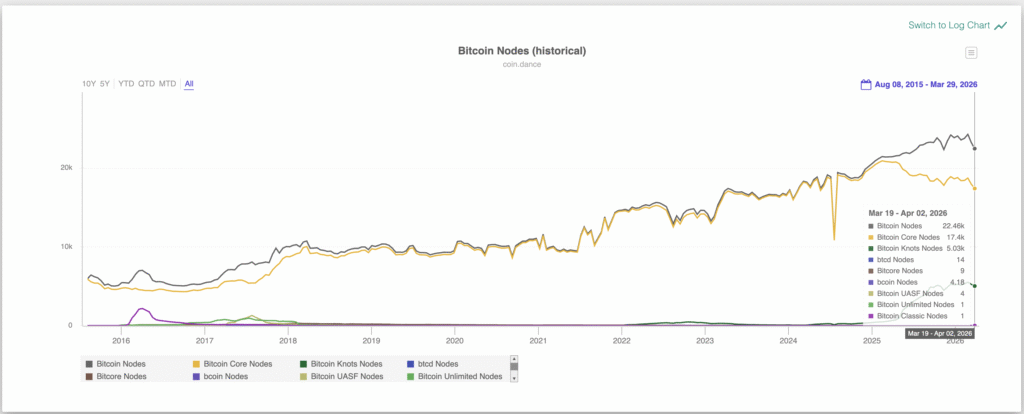
According to CoinDance, there are 23,000+ public Bitcoin nodes, all running with a full or pruned copy of the Bitcoin blockchain and working each day to validate transactions and broadcast transactions. Some nodes, deemed “economic nodes,” work harder than others; for example, a node run by an exchange broadcasts thousands of transactions to the network each day, whereas the average plebeian node does not.
While nodes may differ in workload and contribution to new transactions, they are all created equal when it comes to validating transactions.
While 23,000 nodes sounds like a lot, and is relative to the few servers running your local banks’ infrastructure, it’s still pretty small compared to the number of people who have direct and indirect exposure to the Bitcoin network.
Estimates in 2026 put Bitcoin exposure at around 480 to 500 million people worldwide, according to Bleap Finance. While reports from Glassnode, Chainalysis, and Crypto.com’s 2026 Market Report, nearly half a billion people now hold some amount of Bitcoin.
23,000 nodes, all running on behalf of 500 million people, means a silent minority is actually monitoring the network and verifying transactions.
So much for “don’t trust, verify”.
But the centralisation doesn’t stop there!
Network decentralisation
When most people learn about Bitcoin, they are told about the magic of this decentralised network that runs peer-to-peer without central authorities. But there’s an irony that many overlook: the vast majority of that network—historically over 99%—has relied on a single software implementation.
After Satoshi released the full Bitcoin client, and the network expanded, the mining and node software split off from one another and for nodes, Bitcoin Core is the reference client.
Bitcoin Core remained so dominant that, for years, the distinction between “Bitcoin” and “Bitcoin Core” was blurred in many Bitcoin users’ minds.
Yet in recent years, this monopoly has been challenged.
Alternative implementations are gaining ground, and a new nonprofit has just launched to develop yet another option for businesses and individuals to run on, but why does Bitcoin need more node implementations?
A History of Alternatives
Bitcoin alternatives didn’t just emerge yesterday.
Even in Bitcoin’s relatively early days, developers recognised the value of having multiple client implementations. Projects like Libbitcoin and btcd proved that Bitcoin’s protocol could be implemented independently and successfully. These weren’t flawed experiments; they are niche projects with competent, alternative interpretations of the Bitcoin protocol, each with its own philosophical approach to development.
Libbitcoin offered a modular architecture designed around extensibility and freedom. Meanwhile, btcd, written in Go, provided an alternative implementation that appealed to developers familiar with that language. Both demonstrated that Bitcoin Core wasn’t the only way to run a node, and both found their communities and use cases. More importantly, they proved that the Bitcoin protocol was robust enough to tolerate multiple independent implementations, a crucial requirement for any truly decentralised system.
Yet despite these examples of viable alternatives, Bitcoin Core’s gravity remained almost insurmountable.
It was the first mover, it had the brand, and those network effects were powerful: developers contributed to Bitcoin Core, funding was directed towards Bitcoin Core, because it was the default installation, it received the most scrutiny, and most importantly, the vast majority of node operators simply ran it because everyone else did, and it was easy to run.
By the early 2020s, alternatives were barely visible on the network, representing a rounding error in node distribution statistics, but that has all changed in the last two years.
Bitcoin Node Implementations over the last 10 years – Source: Coin Dance
Bitcoin Core’s Dominance and Lost Ground
For years, Bitcoin Core’s dominance seemed inevitable and perhaps even desirable, given its convenience. We only had to fund one team of developers, review one codebase, and update one piece of software, and, for the most part, there were no issues in the early days.
But that start-up-type mentality would be challenged and forced to change as Bitcoin grew into a $1 trillion+ asset class. So much wealth is maintained within the network that network upkeep becomes a different ball game.
A single, well-maintained reference implementation meant consistency. It meant that when changes were made to the protocol, they were made carefully and with broad community input—or so the story went.
But as Bitcoin matured, tensions emerged within the development community. Certain changes to Bitcoin Core have sparked controversy, such as the removal of the OP_Return Limit and the recent rollback. Some felt that the development process wasn’t as transparent or inclusive as it claimed to be.
Others argued that Bitcoin Core’s direction was influenced by particular factions within the ecosystem, pushing changes that not everyone agreed were aligned with Bitcoin’s original principles. These weren’t abstract disagreements; they were practical concerns about how Bitcoin’s rules were evolving.
Then came Bitcoin Knots, a somewhat dormant client, which became the platform for protest, and so the battle between the Bitcoin Core-communists and the Bitcoin Knotzis began.
Bitcoin Knots Rises to Challenge
Bitcoin Knots emerged as a direct response to these concerns. Created by Luke Dashjr, Bitcoin Knots is essentially Bitcoin Core with a more conservative approach to changes. Rather than automatically adopting every modification that Bitcoin Core implements, Bitcoin Knots allows node operators to opt out of controversial changes on an individual basis. It’s Bitcoin Core for those who want more choice in which parts of the protocol they actively enforce.
The growth of Bitcoin Knots has been striking. What began as a marginal alternative has climbed to represent approximately 22% of Bitcoin nodes in recent network surveys. While not the majority, that’s a meaningful portion of the network actively choosing an alternative based on philosophical differences with Bitcoin Core’s direction.
Node implementation network share as of 2026 – Source: Coin Dance
This shift matters.
A 22% share means that a significant minority of node operators have lost confidence in Bitcoin Core’s development direction. The Knots users are not abandoning Bitcoin; they’re choosing a different way to participate. The fact that this is possible—that the network remains compatible with such a divergence—demonstrates that Bitcoin’s consensus rules and protocol are more robust than any single implementation.
ProductionReady: The Conservative Client
In March 2026, Jimmy Song, Samson Mow, Parker Lewis, and John W. Ratcliff launched ProductionReady, a 501(c)(3) nonprofit focused on advancing open-source Bitcoin development through education and a conservative alternative Bitcoin client.
ProductionReady’s efforts are intended to contribute to the broader Bitcoin development ecosystem by supporting additional contributors and encouraging multiple compatible software implementations. More specifically, the organisation intends to fund a Bitcoin node implementation built on Bitcoin Core, with a focus on conservatism, stability, and fidelity to Bitcoin’s monetary properties.
The ProductionReady team is explicit about their philosophy.
“As Bitcoin matures and the value stored on the network grows into the trillions, it becomes increasingly important to follow a conservative development path that can eventually lead to ossification. Having multiple well-maintained Bitcoin clients with significant adoption will bring greater balance to the ecosystem, ensuring that no single implementation can dictate the direction of development.”
– Samson Mow
Ossification—the intentional slowing down of changes as a system matures—is a controversial idea in Bitcoin development. Some see it as crucial for Bitcoin’s long-term stability and security. Others worry it could make Bitcoin unable to adapt to genuine problems. But the existence of multiple implementations actually resolves this tension.
If Bitcoin Core innovates and takes risks, while ProductionReady takes a more conservative approach, the network benefits from both strategies.
Users can choose their own risk tolerance.
We’re excited to officially announce @ProductionReady, a 501(c)(3) public charity established by @Excellion, @jimmysong, @parkeralewis, and @jratcliff to advance open-source Bitcoin development through education and funding for a new conservative Bitcoin client.
The case for multiple node implementations goes far beyond philosophical preference or the prevention of the dominance of any single organisation. It touches on the fundamental security and integrity of Bitcoin as a system, and is part of the network’s ethos, of battling centralisation and relying on trusting a single party or point of failure.
Network Resilience: A bug or vulnerability in a single implementation could potentially compromise a large portion of the network if that implementation dominates. With multiple well-maintained clients each running significant portions of the network, such a bug would only affect part of the ecosystem. The rest would continue validating blocks correctly, protecting the whole.
Preventing Consensus Capture: When all nodes run the same code, the entity controlling that codebase effectively controls Bitcoin’s consensus rules. This is precisely the kind of subtle centralisation that Bitcoin was designed to prevent. Multiple implementations make it exponentially harder for any single organisation or group to capture Bitcoin’s rules.
Protection Against Pressure: As Bitcoin’s value grows and its geopolitical importance increases, there will be external pressure on Bitcoin Core maintainers to implement changes that serve particular interests—governments, corporations, wealthy stakeholders. These pressures might be explicit or subtle, coercive or merely persuasive. But they’re coming. Having alternative implementations ensures that even if Bitcoin Core yields to such pressure, other viable clients remain that users can switch to. This protection against coercion is what a truly decentralised network requires.
Ideological Diversity: Different developers have different visions for Bitcoin’s future. Some prioritise scalability, others security, others privacy, others simplicity. With multiple implementations, these different visions can coexist and compete in the marketplace of ideas. Users vote with their computational power.
Preventing Corruption: Perhaps most importantly, multiple implementations are the ultimate check against gradual, unintentional corruption of Bitcoin’s values. Over time, institutions and people can drift from their principles. Individuals change positions, organisations get compromised, and incentive structures shift. An alternative implementation is like a backup copy of Bitcoin’s original vision, available to be activated if the primary implementation ever truly strays.
The Competitive Node Landscape
Regardless of which side you take, we’re entering a new era for Bitcoin node implementations. For the first time since Bitcoin Core’s early dominance, meaningful alternatives are emerging. Bitcoin Knots has proven there’s demand for a more conservative approach.
ProductionReady is arriving with professional backing and a clear mission. Other alternatives will undoubtedly follow, and hopefully, they will find their own identity and bring forth new ideas that Knots might not be comfortable running.
There’s really no point in having another client that is different in name only, or users could simply choose not to upgrade when new versions are proposed. Each implementation will need to carve out its niche and appeal to a certain interested cohort.
And this isn’t a bad thing, as this isn’t a fork or a split in Bitcoin’s consensus. All these implementations follow the same protocol rules and accept the same valid blocks. Users running different clients are still part of the same network and validate the same blockchain.
But they’re doing so with choices about which trade-offs matter most to them.
This competitive landscape is exactly what Bitcoin needs as it matures. As the value stored on the Bitcoin network grows into the trillions, the health of the entire system depends on there being multiple, well-maintained implementations that node operators can choose from. Not because any one client is perfect, but because perfection in decentralised systems is impossible.
In decentralised systems, redundancy is resilience, and diversity is security.
The rise of alternatives doesn’t mean Bitcoin Core was a failure. Bitcoin Core remains a crucial implementation and will likely remain the most widely used. But its dominance no longer goes unquestioned. And that questioning, that competition, that choice—that’s exactly what keeps Bitcoin’s promise of decentralisation alive.
Disclaimer: This article should not be taken as, and is not intended to provide any investment advice. It is for educational and entertainment purposes only. As of the time posting, the writers may or may not have holdings in some of the coins or tokens they cover. Please conduct your own thorough research before investing in any cryptocurrency, as all investments contain risk.All opinions expressed in these articles are my own and are in no way a reflection of the opinions of The Bitcoin Manual
Che Kohler
South African bitcoin pleb falling down the rabbit hole and willing to share every bump, scratch and knock along the way
On August 17, 2026, Swiss hardware wallet maker BitBox disclosed and patched two “severe” vulnerabilities in its BitBox02 and BitBox02 Nova devices, alongside a previously
Cookie policy
We use our own and third party cookies to allow us to understand how the site is used and to support our marketing campaigns.