The Bitcoin mining landscape is experiencing a quiet revolution this cycle.
While corporate miners consolidate around predictable payout models, a counterculture of “pleb miners” is emerging with the help of open-source mining projects—hobbyists running Nerd Miners, NerdAxes, and BitAxe miners next to their Raspberry Pi nodes, enthusiasts heating their homes with ASICs, and privacy-conscious bitcoiners earning KYC-free sats.
The hash rate many of these lottery miners generate is minuscule, especially as we enter the 1 Zetahash era, so miners have had to choose, try to play in larger pools where they could stack drips of Sats, hoping to reach the minimum payout threshold or go full degen and lottery mine with a solo pool.
Into this movement steps Parasite Pool, a new mining pool with an unconventional payout model that turns traditional mining economics on its head with a simple philosophy: “Plebs eat first.”
Founded by ZK Shark, creator of Ordinal Maxi Biz, Parasite Pool joins a growing league of cottage industry Bitcoin mining startups challenging the industrial status quo..in a way.
But what makes Parasite Pool different isn’t just its zero-fee structure—that’s just the initial incentive to get users to contribute hashrate, and it can’t sustain itself as a business model. The primary difference in Parasite Pool is its approach to mining rewards distribution, designed specifically to attract small miners while solving real problems plaguing the industry.
Understanding Bitcoin Mining Pool Payout Methods
Before we dive into what makes Parasite Pool different from other pool payout systems, let’s look at the various payout methods used by mining pools.
Full Pay Per Share (FPPS): The Corporate Favourite
Full Pay Per Share has become the dominant payout structure in Bitcoin mining, and for good reason from a miner’s perspective. In FPPS, miners receive consistent payouts for every share they submit to the pool, regardless of whether the pool actually finds a block. The pool essentially acts as a treasury, absorbing all the variance and statistical uncertainty of block discovery.
Think of it like this: Bitcoin block discovery is probabilistic. A pool with 1% of the network hashrate should find one block every 100 blocks on average, but that’s just statistics—they might find two blocks back-to-back, or go 300 blocks without finding one. FPPS shields individual miners from this variance by paying them predictably based on their contributed hashrate.
For large-scale mining operations with monthly expenses like power bills, staff salaries, and loan payments, this predictability is invaluable. However, FPPS comes with significant downsides. Pools typically charge 2-4% fees to maintain the treasury needed to smooth out variance. More critically, FPPS has centralising effects on the Bitcoin network, concentrating hashrate in the hands of a few large pools that can afford to manage this variance.
Pay Per Last N Shares (PPLNS): The Traditional Alternative
PPLNS takes a different approach. Instead of guaranteeing payment for every share, PPLNS only pays out when the pool actually finds a block. The reward is then distributed among miners who contributed shares within a recent window—typically the last one million shares or shares from the past 24 hours.
This model eliminates the need for pools to maintain large treasuries and typically comes with lower or zero fees. However, it exposes miners to significant variance. If you’re a small miner who contributed shares but the pool goes through a dry spell and doesn’t find blocks for weeks, you receive nothing during that period. The feast-or-famine nature of PPLNS makes it challenging for miners who depend on consistent revenue to cover operational costs.
Solo/Lottery Mining: The Ultimate Gamble
At the opposite extreme from FPPS sits solo or lottery mining. In this model, individual miners (or small groups pooling their hashrate) compete to find blocks on their own. If you find a block, you receive the entire block reward—currently 3.125 BTC plus transaction fees, worth approximately $320,000 at today’s prices. If you don’t find a block, you receive nothing.
For most hobbyist miners, solo mining is effectively playing the lottery. A single BitAxe miner producing a few hundred gigahashes per second would take centuries on average to find a block. Despite the astronomical odds, solo mining has gained popularity in the pleb mining movement as an ideological statement against centralisation—and for the sheer thrill of potentially hitting the jackpot.
Parasite Pool’s Hybrid Innovation: Best of Both Worlds
This is where Parasite Pool enters the picture with a genuinely novel approach that attempts to capture the benefits of multiple payout models while minimising their drawbacks.
The Core Model: Plebs Eat First
Parasite Pool’s payout structure is elegantly simple yet revolutionary:
When the pool finds a block, the specific worker (mining device) that discovered that block receives 1 BTC immediately. The remaining reward (approximately 2.125 BTC plus transaction fees) is distributed proportionally among all pool participants based on their contributed shares since the pool’s last block.
Let’s unpack why this matters. The 1 BTC “finder’s fee” preserves the lottery excitement and massive payday potential that makes solo mining attractive to hobbyists. If you’re running a few BitAxe miners in your home office, there’s still that possibility of waking up to 1 BTC in your wallet—a life-changing sum for most people.
But unlike pure solo mining, you’re not left with nothing if someone else finds the block. You still receive a proportional share of the remaining 2.125 BTC based on your contributed hashrate. This hybrid approach means pleb miners can maintain economic viability while still having lottery upside.
Technical Structure: PPLNS Without the Window
From a technical perspective, Parasite Pool operates similarly to PPLNS, but with a crucial difference. Traditional PPLNS pools use a rolling window—they might count only the last million shares or shares from the past day. Parasite Pool instead includes all cumulative shares contributed since the pool’s most recent block.
This means that if you start mining on Parasite Pool today and the pool finds a block six months from now, your shares from today will still count toward your payout allocation. There’s no arbitrary cutoff where your work becomes irrelevant. This creates stronger incentives for long-term participation and loyalty to the pool.
Zero Fees and Real Decentralisation
Parasite Pool charges zero fees. This is possible because the pool doesn’t need to maintain a treasury to smooth variance like FPPS pools do. The economic model is straightforward: when a block is found, rewards are immediately distributed based on a predetermined formula. No middleman taking a cut, no complex accounting systems required.
This zero-fee structure is particularly important for small miners operating on thin margins. A 3% pool fee might seem small, but when you’re running a few hundred watts of mining equipment and barely breaking even on electricity costs, that 3% can be the difference between a hobby that pays for itself and one that slowly drains your wallet.
Why Parasite Pool Targets Pleb Miners
The design choices behind Parasite Pool reveal a deep understanding of what small-scale miners actually need and want from a mining pool.
Lightning Network Integration: Instant Payouts
One of Parasite Pool’s most impressive technical achievements is bypassing Bitcoin’s 100-block maturity rule through Lightning Network integration. Normally, freshly mined Bitcoin cannot be spent for 100 blocks (approximately 16-17 hours) due to consensus rules designed to handle blockchain reorganisations.
Parasite Pool sidesteps this constraint by delivering payouts to Lightning wallets within blocks. The exact mechanism isn’t fully disclosed, but it likely involves either pool subsidisation for early blocks or sophisticated Lightning channel management from the coinbase transaction itself. Regardless of the technical implementation, the result is transformative: miners can receive and spend their earnings almost immediately.
This Lightning integration also enables a withdrawal minimum of just 10 satoshis—effectively no minimum at all. Traditional pools often require miners to accumulate 0.001 BTC or more before receiving a payout. For a small miner earning a few thousand satoshis per day, waiting weeks or months to reach payout threshold adds unnecessary friction and risk (what if the pool shuts down before you hit the minimum?).
Through partnerships with Sati and Xverse, Parasite Pool provides streamlined infrastructure where plebs can simply connect their wallet, point their miners, and start receiving Lightning payouts immediately. This “connect your wallet” approach, borrowed from the crypto wallet interface paradigm, dramatically lowers the barrier to entry compared to traditional pool registration processes.
Economic Viability for Home Miners
Let’s be honest about the economics of small-scale Bitcoin mining in 2025: it’s tough. Industrial miners benefit from economies of scale—negotiated power rates, optimised cooling, bulk hardware purchases, and professional operations teams. Home miners pay retail electricity rates, deal with noise and heat constraints, and often mine at a loss if judged purely on financial return.
What Parasite Pool offers is a middle path. Yes, you’re accepting a 22% discount on your share of block rewards (receiving approximately 2.125 BTC distributed among all miners rather than the full 3.125 BTC). But in exchange, you’re getting consistent payouts rather than the all-or-nothing nature of solo mining, zero pool fees, and that 1 BTC lottery opportunity.
For many home miners, the primary motivations aren’t purely economic anyway. They’re mining to support network decentralisation, to earn KYC-free Bitcoin, to heat their homes with useful computation, or simply for the joy of participating directly in Bitcoin’s proof-of-work consensus. Parasite Pool’s model acknowledges these motivations while still maintaining better economic viability than pure solo mining.
Reduced Block Withholding Incentives
Block withholding attacks represent one of the most pernicious threats to mining pool economics. In this attack, a malicious miner submits shares to a pool but intentionally discards any shares that would actually solve a block. They collect payouts from the pool while reducing the pool’s overall block-finding success rate.
Parasite Pool’s hybrid model creates interesting game theory that reduces the incentive for block withholding. If you’re mining honestly and find a block, you immediately receive 1 BTC—a substantial reward that you forfeit if you withhold the block. While you’d theoretically receive proportional shares from other miners’ discovered blocks, the direct 1 BTC incentive for honest behaviour is powerful.
This mechanism doesn’t eliminate block withholding entirely, but it does create stronger economic incentives for honest participation compared to traditional pool models.
Who Should Mine on Parasite Pool?
Based on the unique characteristics of Parasite Pool’s payout model, certain types of miners stand to benefit most:
- Home Miners and Hobbyists: If you’re running BitAxe miners, small ASICs, or even GPU mining operations in your home, Parasite Pool offers the best combination of lottery excitement and economic sustainability. You maintain the thrill of potentially hitting a 1 BTC payday while ensuring you’re not mining at a complete loss.
- Privacy-Conscious Bitcoiners: The Lightning payout system and low barriers to entry make it easy to mine and receive KYC-free sats without jumping through the registration hoops required by many larger pools.
- Ideological Decentralisation Advocates: If you believe in Bitcoin’s decentralisation ethos and want to actively push back against the concentration of hashrate in FPPS pools, Parasite Pool offers a practical way to contribute to network decentralisation without sacrificing all economic viability.
- Small-Scale Commercial Miners: Interestingly, Parasite Pool might even appeal to small commercial operations looking for a solo mining alternative with downside protection. While you’re accepting lower expected returns compared to FPPS, you’re also not paying pool fees, and you retain significant upside if you find a block.
The Bootstrapping: Building Hashrate
Transparency is important here: as of this writing, Parasite Pool has approximately 24.92 petahashes per second (PH/s) of hashrate—roughly 0.0025%% of Bitcoin’s total network hashrate.
At this level, the pool has an expected time of 291+ days before finding a block.
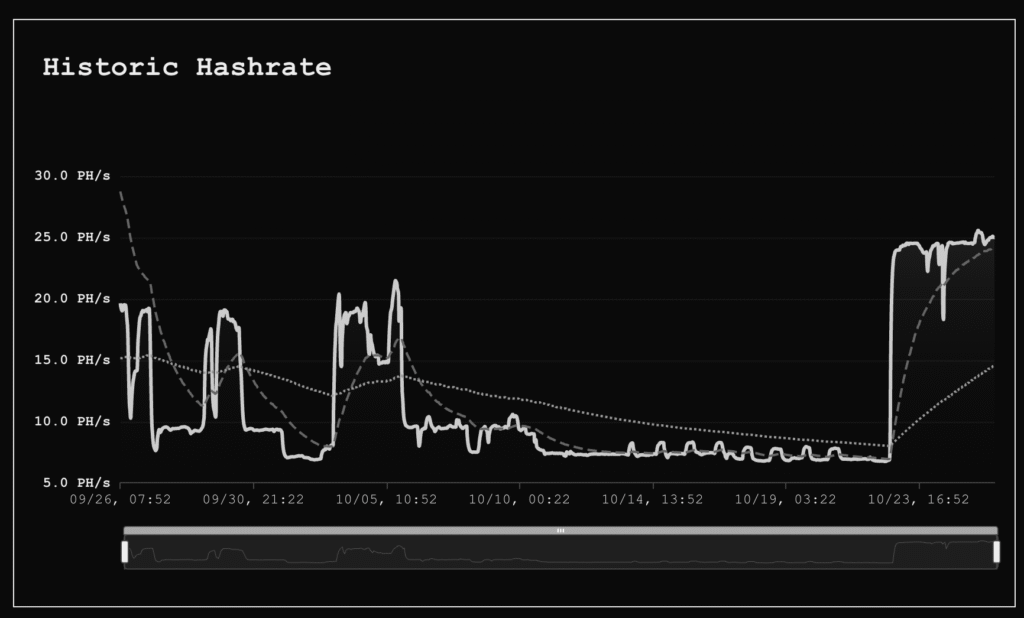
This presents a classic chicken-and-egg problem. The pool needs more hashrate to find blocks more frequently, but miners may be hesitant to contribute hashrate when blocks are infrequent. However, it’s worth noting that the pool is still in beta, hasn’t been heavily advertised, and represents what appears to be a V1 product with plans for additional features and potential open-sourcing of components.
For early adopters, this early stage presents both risk and opportunity. Your contributed shares will count toward the eventual block reward whenever it arrives, and as an early participant, your proportional share of that reward could be substantial if the pool’s hashrate grows significantly before finding its first block.
But how long miners are willing to wait is anyone’s guess. The longer the pool doesn’t deliver a block, the more disheartened miners will become and may switch back to pools with better odds.
The Broader Context: Mining’s Decentralisation Renaissance
Parasite Pool emerges within a broader renaissance of pleb Bitcoin mining, which I do think is a worthwhile endeavour, for hobbyist miners looking to play the odds.
The BitAxe open-source mining project has made it possible for hobbyists to build their own efficient ASIC miners, breaking the hardware monopoly traditionally held by a few manufacturers. The lottery mining trend represented by pools like ckpool and solopool has brought excitement back to small-scale mining.
Meanwhile, for more competitive miners, Ocean mining pool has focused on transparent block template selection, allowing miners to see and control what transactions they’re including in blocks.
Each of these initiatives pushes back against the centralisation trends that have dominated Bitcoin mining’s industrial era. Parasite Pool contributes to this movement with economic innovation—rethinking the fundamental incentive structures that govern how mining rewards are distributed.
Looking Forward: The Survival of Parasite Pool
ZK Shark has indicated plans to open-source components of Parasite Pool over time, suggesting that what we’re seeing now is just the beginning.
Several potential directions could make the pool even more compelling:
The “loyalty” metric currently displayed on the pool dashboard hints at future features that could reward long-term, honest miners with preferential treatment or bonus incentives. Expanding this concept could create sophisticated reputation systems that further discourage malicious behaviour.
- Additional Lightning infrastructure improvements could make receiving and managing mining payouts even more seamless, potentially integrating with broader Lightning services for automatic reinvestment, savings, or spending.
- Enhanced transparency and customisation around block template selection could attract miners who care not just about payouts but about which transactions they’re helping to confirm—a feature that Ocean has pioneered and that aligns well with the ethos of pleb mining.
A Pool for the Pleb Mining Movement
Parasite Pool is a thoughtful market alternative to mining incentives, specifically designed for people who mine Bitcoin —not because it’s the most profitable venture, but because they believe in Bitcoin’s mission and want to participate directly in securing the network.
By combining lottery excitement with economic sustainability, zero fees with instant Lightning payouts, and technical innovation with accessible user experience, Parasite Pool offers small miners a genuine alternative to both the variance of solo mining and the centralisation of FPPS pools.
Will it disrupt the dominance of large industrial pools? Perhaps not immediately.
Building hashrate takes time, and the pool needs to find its first few blocks to prove the model works in practice. But for the growing community of pleb miners—those running home mining setups, heating their homes with useful computation, stacking KYC-free sats, and pushing back against mining centralisation—Parasite Pool provides exactly what they’ve been asking for: a pool where plebs eat first.
If you’re interested in contributing to Bitcoin mining decentralisation while maintaining economic viability and retaining lottery upside, Parasite Pool deserves some consideration. Connect your wallet, point your miners, and become part of Bitcoin mining’s pleb revolution.
Are you a Bitcoin mining enthusiast?
Are you a pleb miner? Which mining pool is your favourite? Do you have one you’d like us to cover? Let us know in the comments down below.
If you’d like to learn more about this mining pool or give it a try, check out the links below.