Despite the drama surrounding the release of Core 30 and the fact that Bitcoin continues to hover above $ 100,000, this latest bull cycle has been relatively uneventful.
The news cycle has been slow, and the arguments on Twitter have been far less entertaining when compared to previous cycles. Despite the lull, Bitcoin chugs on reaching new highs, not in price..yet!
Hash rate tends to be a leading indicator, and price tends to follow, or so we like to believe. Trends are trends until the correlation breaks, right? But for now, let’s just run with it as being partially true.
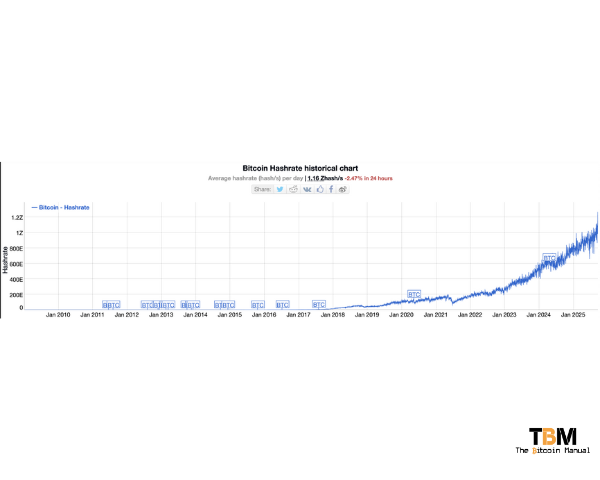
The Bitcoin network’s hashrate has officially crossed the one zetahash per second (ZH/s) threshold, representing 1,000,000,000,000,000,000,000 hashes computed every single second.
Man, that’s a lot of zeros, and you thought eight decimal places were a pain to deal with when pricing things in Satoshis.
This historic milestone, reached in September 2025, marks a new level of confidence in the protocol and a moment in Bitcoin history and demonstrates the remarkable growth trajectory of the world’s first and most secure blockchain network.
The milestone hash rate figure underscores Bitcoin’s unprecedented computational dominance but also shows the market’s willingness to commit resources to supporting the network. Capital required to generate that much hash rate per second could have gone into any myriad of investment opportunities, real estate, AI, stocks, but instead was tied up in purchasing energy, setting up ASICS and competing to secure the next block in the chain.
As Michael Saylor says, if you compare the Bitcoin network to any other, with its proof-of-work mechanism, you’d be hard-pressed to scrape together 5% of the other stuff.
The remaining proof-of-work blockchains are still surviving with hash rates that Bitcoin hasn’t seen since 2017.
Understanding the Significance of 1 Zetahash
To get your head around the magnitude of this achievement, we need to get a grip on what this number represents. The network has climbed from under 800 EH/s at the start of 2025 to today’s zetahash scale, with roughly 30% of the hashrate deriving from U.S. publicly listed Bitcoin miners.
This exponential growth reflects not just technological advancement, but also increasing institutional confidence in Bitcoin’s long-term viability as a digital store of value.
The zetahash milestone represents more than just a numerical achievement – it’s a testament to Bitcoin’s evolving status as the most secure computational network ever created. Each hash represents a cryptographic calculation performed by specialised mining hardware, collectively securing every Bitcoin transaction and maintaining the integrity of the blockchain ledger.
- Dogecoin – 3.20 PH/s
- Bitcoin Cash – 4.84 EH/s
- Litecoin – 2.91 PH/s
- Monero – 6.13 GH/s
Is this a hash rate for ants?

Why Hashrate Growth Matters: The Foundation of Digital Gold
The primary importance of hashrate growth lies in its direct correlation to network security. A higher hashrate makes the Bitcoin network exponentially more resistant to 51% attacks, where malicious actors would need to control the majority of the network’s computational power to alter transaction history. With one zetahash per second, the cost and coordination required for such an attack have become practically insurmountable.
Network Security and Immutability
This security enhancement is crucial for Bitcoin’s role as a global reserve asset. Institutional investors, nation-states, and individual holders can have greater confidence that their Bitcoin holdings are protected by an unprecedented level of computational security. The energy and hardware investment required to maintain this hashrate creates a powerful economic incentive structure that aligns miners’ interests with network security.
Economic Incentives and Miner Participation
The growth to 1 zetahash reflects robust economic incentives that continue to attract miners worldwide. Despite periods of reduced profitability due to lower transaction fees, miners continue to deploy additional hardware, indicating their long-term confidence in Bitcoin’s value proposition. This sustained investment in mining infrastructure represents billions of dollars in specialised hardware and ongoing operational costs.
The distributed nature of this hashrate – spanning multiple continents and involving both large-scale operations and smaller participants – further enhances Bitcoin’s decentralization and resilience. No single entity or jurisdiction can easily compromise the network when computational power is spread across such a vast global infrastructure.
Technological Innovation Driver
Reaching 1 zetahash has catalysed significant innovation in mining hardware and energy efficiency. ASIC manufacturers continue pushing the boundaries of chip design, creating more powerful and energy-efficient miners. This technological arms race benefits the broader semiconductor industry and drives innovations that often find applications beyond cryptocurrency mining.
Bitcoin Hashrate Evolution: A Journey Through the Milestones
Understanding Bitcoin’s current achievement requires examining its remarkable growth trajectory through various computational milestones:
The Early Days (2009-2012): Hash/s to MH/s
Bitcoin’s hashrate journey began modestly when Satoshi Nakamoto mined the genesis block in January 2009. Initially measured in simple hashes per second (H/s), the network quickly scaled to kilohashes (kH/s) as early adopters joined with CPU mining. By 2010, GPU mining emerged, pushing the network into megahash (MH/s) territory.
The GPU Revolution (2011-2013): GH/s Era
As GPU mining became mainstream, Bitcoin’s hashrate reached the gigahash (GH/s) range. This period saw the first major scaling of mining operations and the beginning of mining pools, which allowed smaller miners to combine their computational resources.
ASIC Emergence (2013-2015): TH/s Breakthrough
The introduction of Application-Specific Integrated Circuits (ASICs) specifically designed for Bitcoin mining triggered explosive hashrate growth. The network crossed into terahash (TH/s) territory, marking the professionalisation of Bitcoin mining and the obsolescence of GPU mining for Bitcoin.
Industrial Mining (2016-2019): PH/s and EH/s Milestones
The hashrate was measured in gigahashes per second in 2010, and later in exahashes in 2016. This period saw the emergence of industrial-scale mining operations, with the network scaling from petahashes (PH/s) to exahashes (EH/s). Large mining farms began operating in regions with cheap electricity, fundamentally changing the mining landscape.
Modern Era (2020-2025): The Path to Zetahash
Bitcoin’s hashrate increased by approximately 50% in 2024, setting the stage for the historic zetahash milestone. This recent growth reflects renewed institutional interest, improved mining efficiency, and the maturation of Bitcoin as a global financial asset.
Hash Rate Levels Explained: From Small to Astronomical
Zetahash is a term that will mean very little to those who haven’t paid attention to the networks growth over the last decade. The human brain isn’t designed to process exponential growth, and even with these measurement units, it’s hard to quantify how much power is pointed to Bitcoin for one sat per vbyte blocks these days.
But to give you a crash course in how this power scaling works, here’s the break down!
Basic Units
- Hash/s (H/s): The fundamental unit, representing one calculation per second
- Kilohash/s (kH/s): 1,000 hashes per second
- Megahash/s (MH/s): 1,000,000 hashes per second
Industrial Scale
- Gigahash/s (GH/s): 1 billion hashes per second
- Terahash/s (TH/s): 1 trillion hashes per second
- Petahash/s (PH/s): 1 quadrillion hashes per second
Global Network Scale
- Exahash/s (EH/s): 1 quintillion hashes per second
- Zetahash/s (ZH/s): 1 sextillion hashes per second
- Yottahash/s (YH/s): 1 septillion hashes per second
Each progression represents a thousand-fold increase in computational power, illustrating the exponential nature of Bitcoin’s growth.
The Road Ahead: What’s Next After Zetahash?
With the 1 zetahash milestone now achieved, the natural question becomes: what’s next for Bitcoin’s hashrate growth?
The next major milestone would be reaching the yottahash (YH/s) level – representing 1,000 zetahashes per second, or 1,000,000,000,000,000,000,000,000 hashes per second.
Factors Influencing Future Growth
- Technological Advancement: Continued improvements in ASIC efficiency and the potential transition to more advanced semiconductor processes will drive hashrate growth. Each generation of mining hardware typically offers significant improvements in hash-per-watt ratios.
- Energy Infrastructure: The development of renewable energy projects specifically for Bitcoin mining, along with improved grid integration and energy storage solutions, will support sustained hashrate expansion.
- Institutional Adoption: Growing institutional interest in Bitcoin mining, either through direct participation or investment in mining companies, provides capital for network expansion.
- Geographic Distribution: As mining operations expand into new regions with favourable energy costs and regulatory environments, the global hashrate will continue growing while improving decentralisation.
Another Chapter in Digital Monetary History
The journey to 1 zetahash has been remarkable, but it’s likely just the beginning of Bitcoin’s computational growth story. As the network continues to expand, we’re seeing nation states’ mining operations and a global competition for hash rate heat up. While a large portion of hash rate comes from publicly traded companies and industrial level miners, it hasn’t stopped individuals from competing from as small as a BitAxe or NerdAxe or as large as a few ASICS in a garage.
Growth in hash rate is important, but if it all comes from one party, it’s not exactly helping the network. It’s also about the distribution of hash rate and competition between miners of all shapes, sizes, beliefs and preferences, that’s what makes the network uncensorable and robust.
Each new milestone will further cement Bitcoin’s position as the most secure and robust monetary network ever created, capable of serving as the foundation for a truly global, borderless financial system.
As we look toward future milestones like yottahash and beyond, we witness the continued maturation of Bitcoin from a fringe digital currency to the backbone of a new global monetary system. The one zetahash milestone stands as proof that decentralised networks can achieve scales of security and efficiency that rival and potentially surpass traditional financial infrastructure.