On June 1, 2026, Liquid Network successfully activated ELIP-203, a coordinated hard fork that removes a constraint from the Bitcoin sidechain that was part of its legacy launch, and is a sign that the chain is looking to expand its reach beyond being just another way to move Bitcoin off-chain. Lightning has already captured the majority of the microtransaction market, and barring a few spikes in block space bidding on the main chain, Liquid use has been pretty flat.
On the positive side, this hard fork went ahead without any issues, which is great for Liquid users and confidence in the network, but on the other end, critics will say such a smooth hard fork means you’re pretty much admitting to centralisation without saying it out loud.
All Liquid Federation members and the majority of Liquid node runners are pretty much in agreement with the direction of the chain’s development, with Blockstream leading it, so I don’t see why even a hard fork wouldn’t gain consensus pretty easily.
All chain maintainers have a vested interest in improving it to earn fees and to justify their involvement and support for the network.
So What’s New In The Ocean Blue?
For the first time in Liquid’s history, issuers can create and manage assets with supply limits exceeding 21 million units—a ceiling inherited from Bitcoin’s own monetary policy. This seemingly technical change has opened up opportunities for financial institutions, corporations, and developers to use Liquid as Bitcoin’s native settlement layer for real-world assets outside Bitcoin.
The upgrade represents the first major activation under Liquid’s new development roadmap and positions the network as infrastructure for enterprise-scale tokenisation. Where Liquid was previously forced to fit all digital assets into Bitcoin’s native scarcity model, ELIP-203 allows issuers to work with supplies that reflect the actual economics of real-world assets.
- Tokenised Bond markets.
- Tokenised Securities.
- Tokenised commodities.
- Perpetual Futures.
- And other fiat currencies or fiat-denominated instruments, such as tokenised gift cards and more.
All of these can now exist on Liquid without artificial constraints.
What Is ELIP-203? Understanding the Hard Fork
ELIP stands for ‘Elements Improvement Proposal’—the development framework that governs upgrades to the Liquid Network. ELIP-203 is a specific proposal that removes the 21 million issuance cap for all non-LBTC assets on Liquid.
LBTC (Liquid Bitcoin) remains subject to the 21 million limit, preserving Bitcoin’s monetary policy on the sidechain. But every other asset—whether that’s a stablecoin, a security token, a commodity representation, or a proprietary token—can now be issued in quantities that exceed 21 million.
While this might sound like a minor technical adjustment, it’s a change to how Liquid Network’s consensus rules operate.
Blockstream coordinated the upgrade with Liquid’s Federation members—the operators who run the network. The activation followed Liquid’s typical six-month upgrade cadence, consistent with the timeline used for previous hard forks, such as the Dynamic Federations (DynaFed) update.
Node operators received advance notice and were required to upgrade their Elements nodes to version 23.3.1 or later before the June 1, 2026, activation date.
Why Did Liquid Need a Hard Fork? The Constraint Problem
When Blockstream designed Liquid as a Bitcoin sidechain, they inherited Bitcoin’s fundamental design principle: a fixed, predictable monetary supply capped at 21 million units. This architectural choice made sense for Bitcoin. It embodied the promise of absolute scarcity. A currency that can never be inflated because the supply is mathematically bounded.
But Liquid has found that being another blockchain for moving Bitcoin and stablecoins hasn’t been enough to capture market share or grow the network to a significant size, even compared to popular altcoin chains, let alone capture a large percentage of Bitcoin volume.
Liquid has already dipped its toes into hosting alternative assets like
- MSTR tokenised stocks
- Blockstream mining note
- US T-Bills
- Stablecoins
A New Life For Liquid
Your average Bitcoin Maxi is not going to use Liquid out of principle, and your average Bitcoin user isn’t going to use Liquid because it takes additional steps. Most Bitcoiners who use any kind of liquid transaction do so via swap services or wallets that handle layer interactions for them, rather than directly interacting with the chain.
That’s not enough to justify the chain’s existence, so aiming to grow institutional adoption is a logical next step, since these users won’t have any ethical or technical qualms with using the side chain.
Liquid is now looking to become a wider financial settlement layer—a place where institutions could issue assets backed by real-world value. A bank might issue tokenised securities. A corporation might create a loyalty token. A central bank might issue a digital currency backed by fiat reserves. In all these cases, the amount of the asset that should exist is determined by external reality, not by an arbitrary blockchain limitation.
The 21 million cap became an obstacle.
Consider a bond issuer wanting to represent $50 million in bonds on Liquid: If each token represents $1 of value, they would need 50 million tokens. The network wouldn’t allow it.
Consider a commodity like oil: If someone tokenised oil barrels on Liquid and there were 500 million barrels in the real world, they couldn’t accurately represent that on-chain. The artificial constraint forced issuers into awkward workarounds: either using sub-atomic fractionalization (which complicates UX) or simply not using Liquid.
A bank can issue 100 million tokens, if needed, to represent debt it’s selling. A real-estate firm tokenising properties can issue 1 billion real-estate tokens.
Issuers can now work with supply limits that match their actual needs.
What New Features Does ELIP-203 Add?
Importantly, ELIP-203 is deliberately narrow in scope. It doesn’t add new smart contract capabilities, change transaction fees, or alter Liquid’s security model. It’s a surgical change to one specific consensus rule. This focused approach reduces the surface area for bugs and keeps the upgrade simple to audit.
The timing of ELIP-203 is strategic. Liquid has seen growth in transaction activity, with TVL expanding, Federation membership broadening, and the range of assets becoming more diverse. ELIP-203 is part of efforts to remove bottlenecks that members struggle with in adopting new services and attracting new user bases and capital.
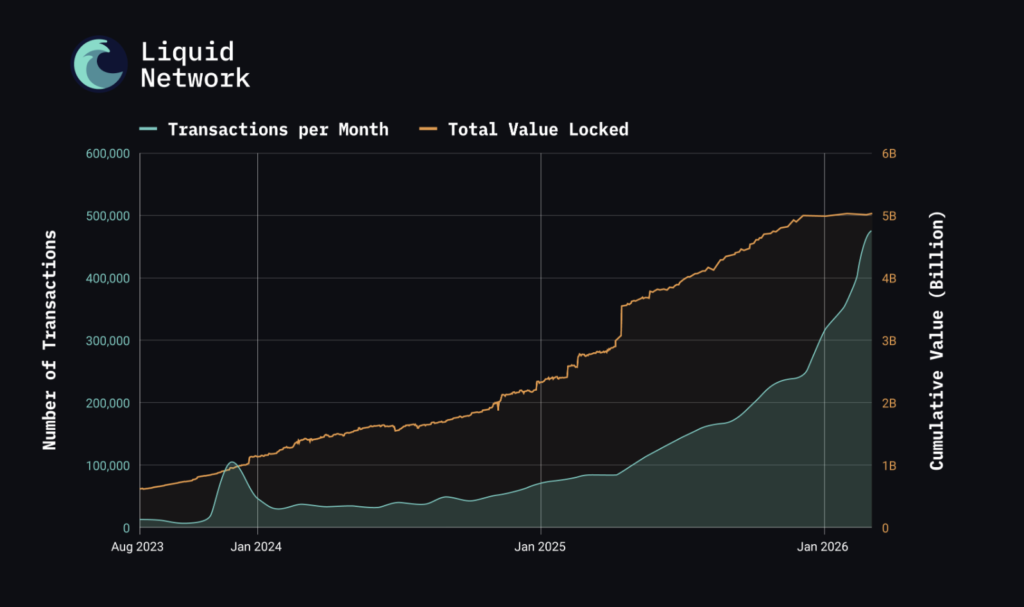
It’s now up to those federation members and anyone building on Liquid to convince institutions to take a chance on the network. The network already supports over $3 billion in tokenised real-world assets, with more than $250 million issued through Bitfinex Securities, and over $1.5 billion in tokenised asset volume via STOKR.
As a comparison, the total value of tokenised Real-World Assets (RWAs) on the Ethereum network exceeds $17 billion. Ethereum commands over 50% of the total RWA market share across all blockchains, so the market currently sits at around $34 billion.
But this doesn’t include the biggest player in this space, which is stablecoins, which is roughly $300 billion.
While the on-chain derivatives market processes over $86 trilllion in trading volume.
What’s Next? The Liquid Roadmap
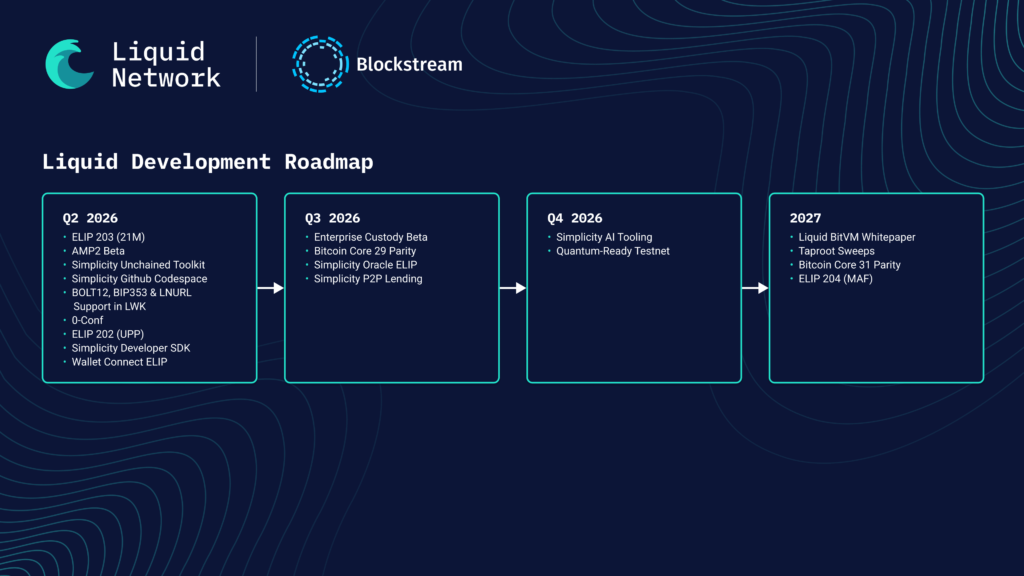
ELIP-203 is explicitly described as ‘the first step’ in Liquid’s broader development roadmap. Several major features are coming from 0-conf transactions to MAF (multi-asset fees) and Taproot sweeps.