If you’re serious about storing your wealth long-term in Bitcoin, self-custody is a priority. History has shown us the risks involved in leaving funds on an exchange, storing funds on an old laptop, holding funds in a hot wallet on your Smartphone, or any wallet that has internet access.
Add to the fact that as Bitcoin grows in size, the modest funds you may have held previously swell in size and paint a larger target on your back, so what might have been adequate security 3,4, or 5 years ago will no longer be applicable.
When Bitcoin was worth a few $100 each, storing them on your Smartphone didn’t seem like a big deal, but at today’s prices, your balance will likely justify investing in a dedicated device to store your seed phrase.
Hardware wallets have long been considered the gold standard for protecting digital assets. However, even the most trusted devices like Ledger and Trezor suffer from a fundamental flaw:
The single point of failure problem. (If you’re using a single sig setup)
This is not to say that any specific signing device is inherently bad; they all have their pros and cons, and as more manufacturers enter the market, they will offer solutions that differentiate themselves or appeal to a different subset of the market.
Let’s look at the options available to us for securing funds.
You essentially have two options: a single signature, which is by far the most popular method of self-custody, or a multi-signature, which requires a little more involvement and extra steps to manage, and the gap between the two custody models leaves room for alternatives.
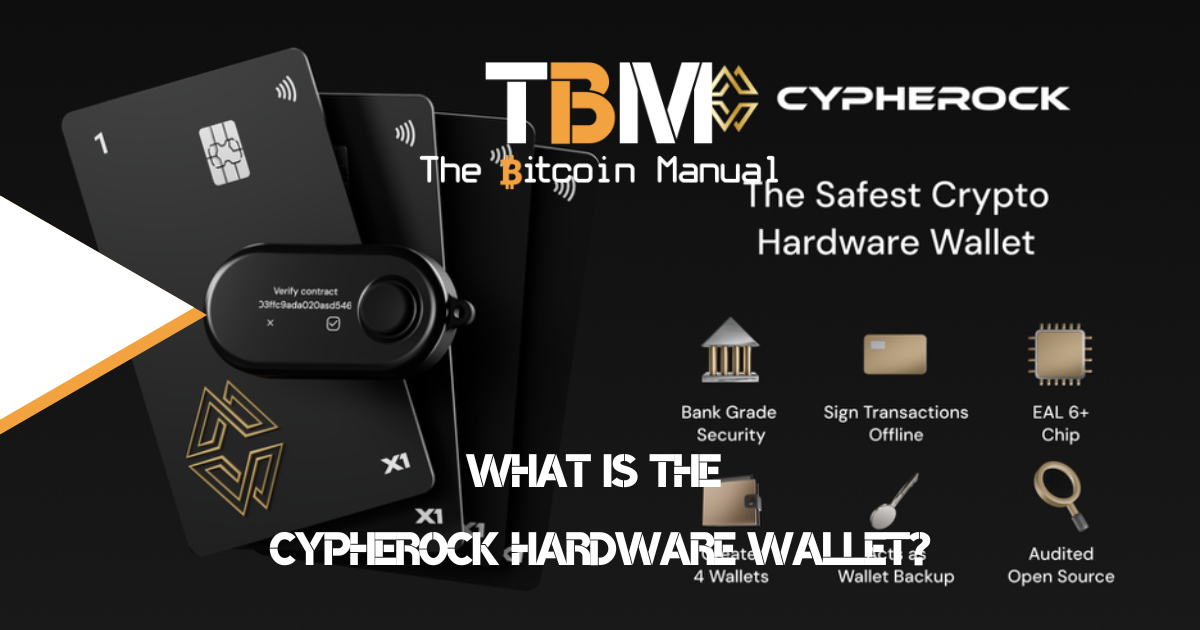
The Cypherock X1 is a hardware wallet that claims to solve this issue through an innovative approach to private key management.
But does it live up to its promises?
What is the Cypherock X1 Hardware Wallet?
The Cypherock X1 represents a shift in hardware wallet design. Unlike traditional hardware wallets that store your private keys in a single device, the Cypherock X1 distributes your private keys across multiple tamper-resistant hardware components using a cryptographic technique called Shamir’s Secret Sharing (SSS).
The Core Innovation: Decentralised Private Key Storage
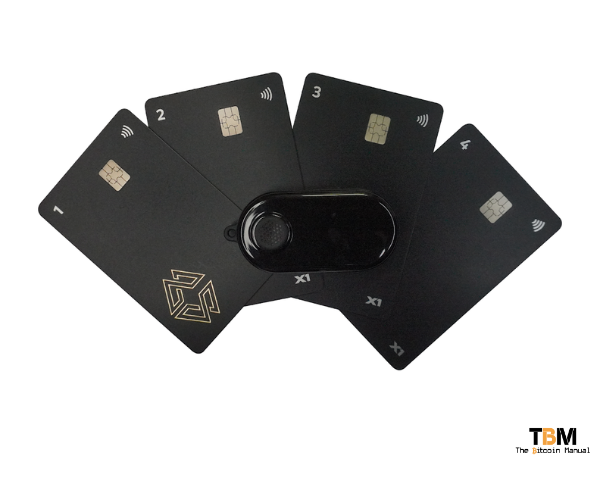
The Cypherock X1 system consists of five components:
- 1 X1 Vault: The main device featuring dual-chip architecture, OLED display, and joystick controls
- 4 X1 Cards: NFC-based smartcards with EAL 6+ secure elements (the same security level as bank credit cards)
Your private keys are cryptographically split into five parts (called “shards”), with each part stored in one of these five components.
The difference lies in the mathematical property that you only need any two of these five components to authorise transactions, meaning you can lose up to three components and still maintain access to your funds.
How Cypherock X1 Differs from Traditional Hardware Wallets
The Cypherock setup takes your traditional private key and allows you to split it up into five shards, which you hold on five different key cards.
Giving you an alternative fallback solution if you ever need to restore your wallet. Of course, you can and always should have a copy of your seed phrase embedded in steel for long-term storage, but these sharded cards are merely a different method of storing those keys.
1. Elimination of Single Point of Failure
Traditional hardware wallets like Ledger store all your private key information in one device. If that device is lost, damaged, or compromised, you must rely on your seed phrase backup.
The Cypherock X1’s distributed approach means no single component holds your complete private key. If you need to restore your key, all you need are two of the five shard cards and your signing device, and you can restore your wallet without the need to input your seed phrase.
2. No Seed Phrase Dependency
Perhaps the most significant difference is that Cypherock X1 users don’t need to manage traditional 12-24 word seed phrases. The Shamir’s Secret Sharing eliminates this requirement, removing the risks associated with seed phrase storage, discovery, or loss.
3. Enhanced Physical Security
The X1 Cards use the same EAL 6+ secure elements found in bank credit cards, while the Vault device features dual-chip architecture for offline computation and verification. This multi-layered approach provides superior physical security compared to single-device solutions.
4. Multiple Wallet Support
The Cypherock X1 can create up to four different wallets within the same device, allowing users to segregate their assets (e.g., separate wallets for DeFi, NFTs, and Bitcoin). It can also import and securely store seed phrases from other BIP39-compatible wallets like Ledger, Trezor, MetaMask, and Trust Wallet.
Key Features and Capabilities
Extensive Cryptocurrency Support
The Cypherock X1 supports Bitcoin as well as over 10,000 cryptocurrencies and tokens, including Ethereum (ETH), Polygon (MATIC), and Dogecoin (DOGE).
While it doesn’t support Bitcoin side-chains like Liquid or Rootstock, it’re looking for a solution that covers all your Bitcoin balances.
Cross chain support his might be an advantage for altcoin users, but a Bitcoiner like myself tends to view this as a negative. Having to manage support for all these fly-by-night coins and failed projects means you take your eye off the ball and don’t focus on the key components, which is security.
This is why I prefer a focused product for my Bitcoin, like the Cold Card and the Blockstream Jade. Sure, you can keep a multi-currency wallet around for your stablecoins or other tokenised assets, but I wouldn’t recommend mixing business with gambling; that’s one man’s opinion.
It’s still an upgrade on leaving your funds in a browser wallet like MetaMask, so if that’s you, maybe it’s time to upgrade your security.
Advanced Security Features
- Security Audits: Audited by KeyLabs, the same firm that has found vulnerabilities in Ledger and Trezor devices
- Open Source: The wallet’s software is open-source and has reproducible builds verified by WalletScrutiny
- Email 2FA: The CySync app includes email two-factor authentication to verify device authenticity
- Passphrase Support: Advanced users can add additional security layers through passphrase functionality
User Experience Enhancements
- CySync App: Comprehensive portfolio management application for all supported assets
- WalletConnect Integration: Seamless connection with decentralised applications (dApps) for DeFi and NFT interactions
- Portfolio Aggregation: View and manage multiple wallet portfolios in a single interface
- Multi-Account Support: Full support for multiple accounts per cryptocurrency
Advantages of the Cypherock X1
1. Distributed Security Architecture
The distributed private key approach genuinely eliminates the single point of failure that plagues traditional hardware wallets. Even if attackers gain access to one or two components, they cannot compromise your funds.
2. Enhanced Backup and Recovery
The elimination of seed phrase dependency removes numerous security risks:
- No physical seed phrase storage required
- No risk of seed phrase discovery by malicious actors
- No need to worry about seed phrase degradation or loss
- Simplified inheritance planning through Cypherock Cover service
3. Flexibility and Convenience
- Transaction authorisation requires only one X1 card and the Vault device
- Multiple wallet creation within a single device
- Ability to serve as a backup manager for other hardware wallets
- Comprehensive portfolio management through CySync
4. Advanced Inheritance Solution
The Cypherock Cover service provides a sophisticated inheritance solution with both Silver (PIN recovery) and Gold (estate recovery) plans, addressing a critical gap in the cryptocurrency ecosystem.
Disadvantages and Limitations
1. Complexity and Learning Curve
While Cypherock claims to simplify crypto security, the system’s complexity may overwhelm newcomers:
- Users must understand and manage five separate components
- The concept of distributed private keys may confuse users familiar with traditional wallets
- Multiple device management increases the potential for user error
2. Higher Cost and Overhead
The Cypherock X1 system is inherently more expensive than traditional hardware wallets due to multiple hardware components:
- Initial purchase cost is higher than single-device alternatives
- Potential replacement costs for lost components
- Cypherock Cover service requires ongoing subscription fees
3. Vendor Lock-in Concerns
Despite claims of preventing vendor lock-in, the Cypherock X1 creates its own form of dependency:
- Users become reliant on Cypherock’s specific implementation of Shamir’s Secret Sharing
- Migration to other wallet systems may be more complex
- Recovery processes are tied to Cypherock’s infrastructure
4. Physical Storage Challenges
While eliminating seed phrases, the system creates new storage challenges:
- Users must securely store and organise five physical components
- Risk of losing multiple components in disasters (fire, flood, theft)
- Potential confusion about which cards belong to which wallets when managing multiple devices
Critical Flaws and Limitations
1. Unproven Long-term Reliability
As a relatively new player in the hardware wallet space (launched in 2022), Cypherock lacks the long-term track record of established competitors:
- Limited real-world testing under diverse conditions
- Potential undiscovered vulnerabilities in the complex multi-component system
- Uncertain company longevity and continued support
2. NFC Security Concerns
The reliance on NFC technology for X1 Cards introduces potential security vectors:
- NFC communications could potentially be intercepted or manipulated
- Physical proximity requirements may create usability challenges
- Potential electromagnetic interference affecting card functionality
3. Complexity vs. Security Trade-off
While the distributed approach eliminates single points of failure, it introduces new complexities:
- More components mean more potential failure points
- User error risks increase with system complexity
- Emergency recovery procedures may be more complicated than traditional seed phrase restoration
4. Limited Third-party Integration
Despite WalletConnect support, the Cypherock X1’s unique architecture may limit integration with some third-party services:
- Some protocols may not fully support the wallet’s signing mechanism
- Limited compatibility with certain multi-signature setups
- Potential issues with hardware wallet integrations that expect traditional architectures
5. Inheritance Service Dependencies
The Cypherock Cover inheritance service, while innovative, introduces centralised dependencies:
- Relies on Cypherock’s continued operation and infrastructure
- Requires ongoing subscription payments for full functionality
- Privacy implications of storing encrypted inheritance data with a third party
Comparative Analysis: Cypherock X1 vs. Traditional Hardware Wallets
| Feature | Cypherock X1 | Traditional Hardware Wallets |
|---|---|---|
| Single Point of Failure | Eliminated through distribution | Present in device/seed phrase |
| Seed Phrase Management | Not required | Essential for backup |
| Initial Cost | Higher (multiple components) | Lower (single device) |
| Setup Complexity | Moderate to High | Low to Moderate |
| Recovery Process | Component-based | Seed phrase-based |
| Multi-wallet Support | Native (up to 4 wallets) | Limited or requires multiple devices |
| Industry Track Record | Limited (launched 2022) | Extensive (5+ years) |
| Third-party Integration | Limited | Widespread |
Who Should Consider the Cypherock X1?
Potential Users:
- High-net-worth individuals concerned about single points of failure
- Advanced users who understand distributed systems and want cutting-edge security
- Estate planners who need sophisticated inheritance solutions
- Portfolio managers handling multiple wallets and diverse crypto assets
- Security-conscious users willing to accept complexity for enhanced protection
- On-chain traders: Users who prefer to use DEX’s and would like to have a wallet to manage their hot keys and cold keys.
Users Who Should Avoid:
- Bitcoin Maxis who need simple, straightforward solution that focuses only on Bitcoin.
- Budget-conscious users prioritising cost over advanced features
- Casual crypto holders with modest portfolios and those who are only in the trade to flip funds.
- Users preferring proven solutions over innovative but unproven technologies
Innovation with Trade-offs
The Cypherock X1 offers a different take on hardware wallet design, addressing real pain points in traditional devices through its distributed private key approach. The elimination of single points of failure and the removal of seed phrase dependencies are significant improvements that could reshape how we think about cryptocurrency security.
However, innovation comes with trade-offs.
The system’s complexity, higher costs, and relative newness may make it unsuitable for many users. While the security improvements are theoretically sound, the long-term reliability and user experience implications remain to be fully proven in real-world scenarios.
However, I do see it finding its own niche.
Having taken my mother through the self-custody process, I think this setup is a little more grandma-friendly once you get it up and running.
The Cypherock X1’s success will ultimately depend on its ability to balance its innovative security features with practical usability, long-term reliability, and competitive pricing.
Whether you choose the Cypherock X1 or a traditional hardware wallet, the most crucial step is transferring your Bitcoin from exchanges to self-custody solutions. The ideal security system is the one you actually use consistently and correctly—and for many users, that may still be a simpler, more traditional approach.
The Tried And Battle-Tested
For users with substantial Bitcoin holdings who prioritise security over simplicity and are willing to invest in cutting-edge solutions, using Bitcoin-only devices and Multi-sig still offers the most compelling security advantages.
Traditional hardware wallets from established manufacturers may remain the better choice for most users, particularly those new to Bitcoin or those seeking proven, straightforward solutions.
Ultimately, I am happy to see new solutions that promote self-custody; anything that gets people to take their funds off an exchange is a win for me. Once you have funds in your possession and interact with your signing device regularly, you can then decide whether to keep using it or switch to a device that better suits your needs.
As is the case with anyone who uses self-custody, you likely have more than one device, in any case, so don’t make the manufacturer your single point of failure either. These devices have a life span, and one that your private key can outlast, so remember that.
And good luck on your self-custody journey, with whatever device you choose to use as your first.
Secure A Discount on Your Cypherock
If you would like to purchase the Cypherock hardware wallet, you can take advantage of our discount code for a 17% discount on the price.
- Discount Link – Coupon code: MANUAL17 (17% discount)
- Standard Link